FrSky Archer Plus GR6 ACCESS / ACCST D16 Glider Receiver
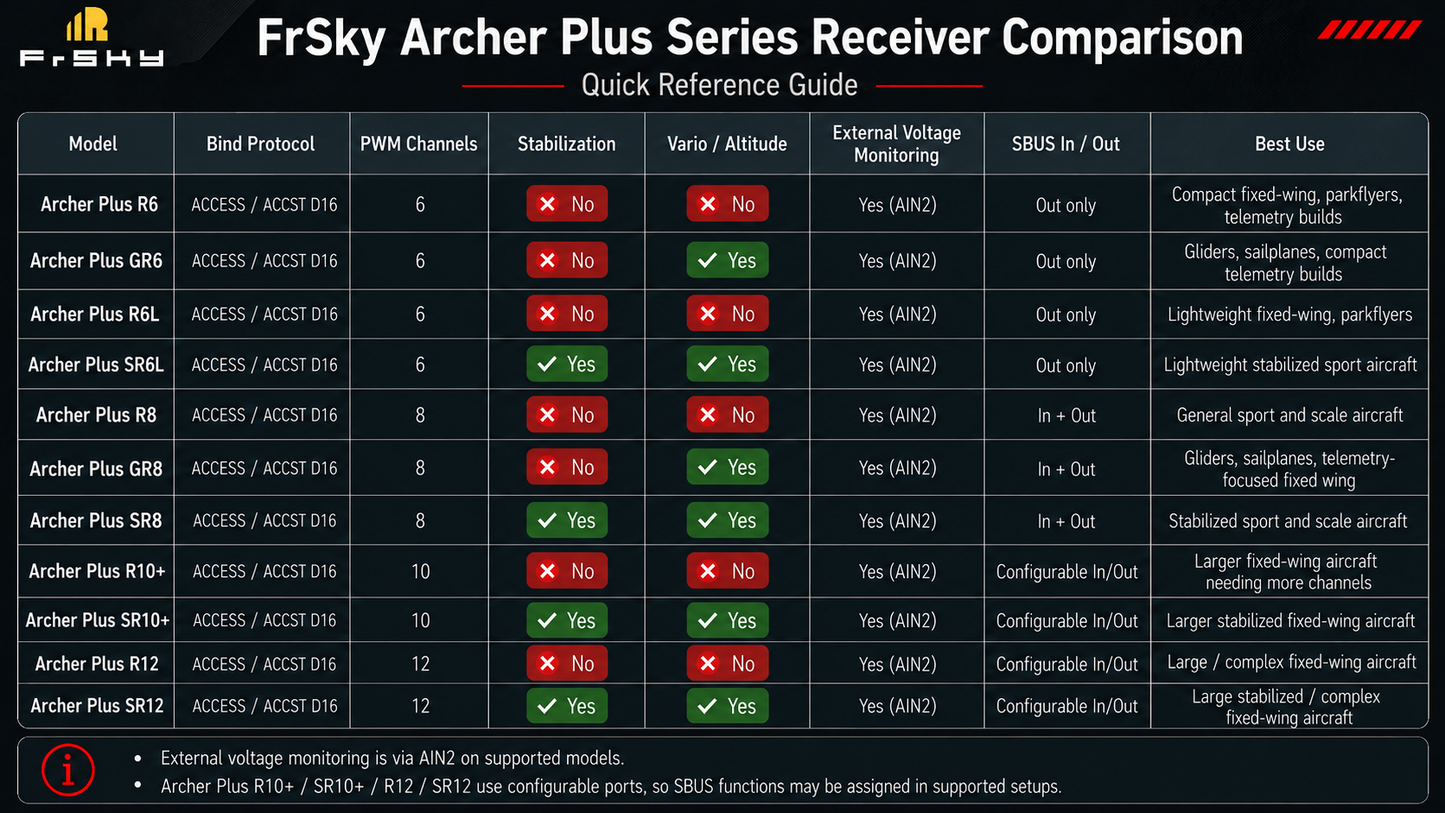
The FrSky Archer Plus GR6 is a compact, full-range 6-channel receiver designed specifically for gliders, sailplanes, powered gliders, and other aircraft where accurate altitude and vertical-speed telemetry are important. Its lightweight 4.3g design, six high-precision PWM outputs, dual detachable antennas, and integrated upgraded variometer make it a strong choice for thermal soaring, slope flying, electric gliders, and compact fixed-wing aircraft.
The Archer Plus GR6 supports both ACCESS and ACCST D16 protocols, providing broad compatibility across FrSky 2.4GHz radio systems. The Archer Plus Series features enhanced anti-RF interference performance and smart protocol matching during binding, helping provide a stable and dependable control connection. A built-in Black Box function can also preserve basic flight information related to receiver power and signal performance.
The GR6 includes an upgraded high-precision variometer that provides faster and more accurate altitude and vertical-speed data. When used with a compatible FrSky telemetry-enabled transmitter, pilots can receive real-time altitude information, vertical-speed readings, and responsive audio feedback to help identify thermals, sink, and changing lift conditions.
The receiver includes six high-precision PWM outputs, SBUS Out with 16-channel or 24-channel support, SBUS In for compatible receiver redundancy, and S.Port or FBUS telemetry. When configured for FBUS operation, compatible FrSky telemetry devices, sensors, and servos can share simplified wiring for a cleaner aircraft installation.
Compatibility Note
The Archer Plus GR6 is compatible with and can bind to all FrSky ECOS, TWIN, and Tandem Series radios that support ACCESS or ACCST D16 protocols. This includes compatible transmitters and RF modules operating in either supported protocol mode.
Some advanced functions, including OTA firmware updates, FBUS device configuration, telemetry setup, and enhanced variometer integration, require a compatible ACCESS and ETHOS system.
The Archer Plus GR6 is not a TWIN TW receiver, Tandem TD receiver, ELRS receiver, Spektrum receiver, Futaba receiver, or FlySky receiver. Use this receiver only with compatible FrSky ACCESS or ACCST D16 radio systems.
Key Features
Compact full-range 6-channel FrSky glider receiver
Supports ACCESS and ACCST D16 protocols
Compatible with all FrSky ECOS, TWIN, and Tandem Series radios that support ACCESS or ACCST D16
Designed for gliders, sailplanes, powered gliders, and thermal soaring aircraft
Upgraded high-precision variometer
Real-time altitude and vertical-speed telemetry
Responsive variometer audio feedback with compatible FrSky transmitters
Smart protocol matching during binding
Enhanced anti-RF interference performance
Built-in Black Box flight-data function
6 high-precision PWM channel outputs
SBUS Out with 16-channel or 24-channel support
SBUS In for compatible receiver redundancy setups
S.Port and FBUS telemetry support
Up to 24 signal channels in supported configurations
External battery or device voltage monitoring
Over-The-Air OTA firmware update support
Dual detachable antennas with IPEX4 connectors
Lightweight 4.3g design
Suitable for gliders, sailplanes, powered gliders, and compact fixed-wing aircraft
Brand: FrSky
• Model: Archer Plus GR6
• Receiver Series: Archer Plus Series
• Receiver Type: Glider receiver with integrated variometer
• RF Protocol: ACCESS / ACCST D16
• Frequency: 2.4GHz
• PWM Channels: 6
• Maximum Signal Channels: 6 PWM / 16 SBUS or 6 PWM / 24 SBUS
• Operating Voltage: 3.5–10V
• Operating Current: Less than 65mA at 5V
• Operating Range: Greater than 2km under ideal conditions
• Telemetry: S.Port / FBUS
• Signal Outputs: PWM / SBUS Out / FBUS
• Redundancy Input: SBUS In
• Variometer: Integrated upgraded high-precision sensor
• Altimeter Measurement Range: -700m to 10,000m
• Altimeter Resolution: 0.1m
• Vertical-Speed Measurement Range: ±10m/s
• External Voltage Detection: AIN2
• AIN2 Measurement Range: 0–35V
• Voltage Divider Ratio: 1:10
• Antennas: Dual detachable 2.4GHz antennas
• Antenna Connectors: IPEX4
• Firmware Updates: Over-The-Air OTA with compatible ACCESS systems
• Black Box Function: Supported
• Dimensions: 33 × 15 × 9.7mm
• Weight: 4.3g
• Compatibility: FrSky 2.4GHz ACCESS or ACCST D16 capable transmitters and RF modules
Actual operating range may vary depending on antenna installation, transmitter output, aircraft construction, terrain, local RF conditions, and environmental conditions.
Select the Correct RF Protocol
Create or open the aircraft model on your FrSky transmitter and select either ACCESS or ACCST D16 to match the receiver firmware and intended operating mode. ACCESS is recommended when supported because it enables additional receiver, telemetry, and firmware-update features.
Binding
Place the transmitter into registration or binding mode for the selected protocol, then power the receiver and follow the current FrSky binding procedure for your transmitter and firmware version.
PWM Connections
Connect standard servos, the ESC throttle lead, spoilers, flaps, tow-release servos, retracts, or other PWM-controlled accessories to the six channel outputs. Verify signal, positive, and negative wire orientation before powering the receiver.
Variometer Setup
Discover the receiver’s altitude and vertical-speed telemetry sensors through the transmitter telemetry menu. Configure altitude, vertical-speed, and variometer audio announcements according to your flying style and transmitter capabilities.
Thermal and Vertical-Speed Alerts
Set practical climb and sink thresholds that allow the transmitter to identify useful lift without creating constant alerts from normal control inputs or turbulence. Test the settings at a safe altitude and adjust them gradually.
Variometer Placement
Install the receiver where it is protected from direct propeller wash, cooling airflow, pressure pulses, and rapidly changing internal air pressure. Sudden pressure changes can affect altitude and vertical-speed readings.
SBUS Out
Use SBUS Out when connecting the receiver to a compatible flight controller, stabilization system, channel expander, decoder, or other SBUS device.
SBUS In and Receiver Redundancy
SBUS In may be used with a compatible secondary FrSky receiver for signal redundancy. Confirm that the secondary receiver, signal format, power arrangement, and receiver settings are compatible before flight.
Telemetry and FBUS
The telemetry connection supports S.Port or FBUS operation with compatible FrSky devices. FBUS allows supported sensors, servos, and control equipment to share simplified wiring.
External Voltage Monitoring
The AIN2 connection supports external battery or device voltage measurement from 0–35V when used with the correct 1:10 voltage divider. Do not connect a flight battery directly to AIN2 without the proper voltage divider or approved voltage-sensing cable.
Antenna Installation
Position the two antennas at different angles to improve signal diversity. Keep both active antenna elements away from carbon fiber, batteries, ESCs, motors, high-current wiring, and other conductive materials. Do not cut, pinch, sharply bend, or modify the antennas.
Firmware Compatibility
Before binding, confirm that the transmitter RF firmware and receiver firmware support the same ACCESS or ACCST D16 version. Firmware mismatches can prevent binding or cause receiver functions to operate incorrectly.
Preflight Check
Confirm correct channel movement, servo direction, failsafe behavior, telemetry operation, altitude readings, vertical-speed response, and control range before flying. Complete a range check after installation and whenever the receiver, antenna placement, transmitter configuration, or aircraft electronics are changed.